May 15, 2026
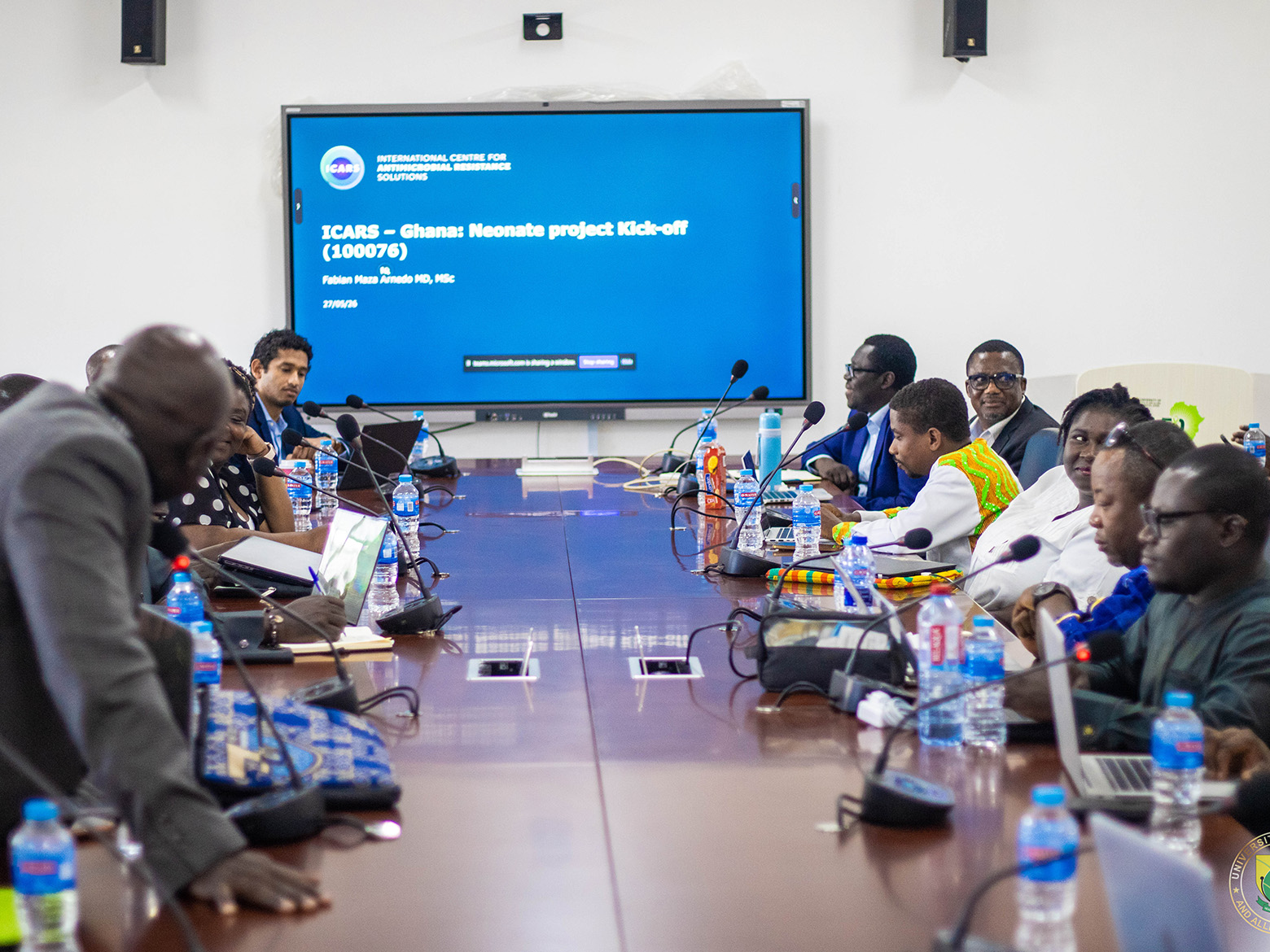
The University of Health and Allied Sciences (UHAS), in partnership with the International Centre for Antimicrobial Resistance Solutions (ICARS) and the Ministry of Health (MoH) Ghana, officially launched a research project on May 7, 2026, aimed at reducing neonatal infections and improving the rational use of antibiotics across four health facilities in the Volta Region. The launch, held at the UHAS Main Campus in Ho, marks the beginning of a multi-site implementation research initiative bringing together clinicians, pharmacists, laboratory scientists, public health professionals and international partners to address one of the most urgent threats to newborn survival in Ghana.
The project is a direct response to alarming trends in neonatal health. According to the study’s Principal Investigator, Dr. Kokou Amegan-Aho, up to 60% of neonates admitted to neonatal intensive care units may have an infection, yet all of them receive antibiotics because of weak diagnostic systems that force clinicians to prescribe empirically. Three out of every four neonatal infections are acquired in healthcare facilities and are fundamentally preventable. More troubling, bacteria such as Klebsiella and E. coli isolated from neonates in some Ghanaian hospitals are now resistant to all available first-line antibiotics, leaving clinicians without effective treatment options.
The project, titled “Enhancing Infection Prevention and Rational Antibiotic Use for Neonatal Infection in Four Health Facilities in the Volta Region, Ghana,” aims to reduce neonatal infections, including drug-resistant infections, by 20% across the participating sites, while strengthening Infection Prevention and Control (IPC) and Antimicrobial Stewardship (AMS) practices at the facility level.
The study is structured around five interconnected Work Packages covering IPC, AMS and diagnostics, behavioural change, economic evaluation and regulation and policy. It will be conducted in three phases a baseline assessment currently underway, a co-creation phase where facility staff and the research team will jointly design context-specific interventions, and a final implementation and evaluation phase. Findings will be documented and disseminated nationally and internationally.
The four participating facilities Ho Teaching Hospital, Volta Regional Hospital in Hohoe, Margaret Marquart Catholic Hospital in Kpando and Keta Municipal Hospital, were selected to represent different levels of the health system and diverse geographic and socioeconomic contexts within the Volta Region, enabling findings to be generalised and scaled across Ghana.
Speaking remotely at the launch, Vice Chancellor Professor Lydia Aziato described the project as a milestone for UHAS, commending UHAS Schools of Pharmacy, UHAS School of Medicine and UHAS School of Basic and Biomedical Sciences for making the multidisciplinary collaboration possible and encouraged all schools and institutes at UHAS to pursue similar research partnerships.
The Pro-Vice Chancellor’s address, delivered by Professor Kwame Ohene Buabeng, Dean of the School of Pharmacy, expressed sincere appreciation to ICARS for the grant and pledged the University’s full institutional support for the project’s success. Professor Buabeng adding his own endorsement, affirmed that the project aligns directly with the newly developed National Antimicrobial Stewardship Strategy and the National Action Plan on AMR, making it a flagship initiative of the highest national relevance.
Professor Evelyn Ansah, who oversaw the proceedings of the launch, framed the event around three principles she asked all participants to uphold throughout the project collaboration over competition, quality over speed and impact over output. She described the occasion not merely as a project launch but as the beginning of a journey to generate evidence for a critical and well-documented public health problems.
National and international partners expressed dedicated support for the initiative. ICARS Science Officer Fabian Augusto Maza Arnedo from Copenhagen, noted that ICARS, founded in 2018 with support from the Danish government and the World Bank, currently runs over seventy-two projects across 33 countries. He described the project as a model of ICARS’ approach of combining top-down policy engagement with bottom-up implementation and highlighted that it includes a PhD candidate and a Master’s student. The Ghana Ministry of Health’s representative from the Antimicrobial Resistance Coordinating Committee (AMRCC) confirmed the Ministry’s involvement from the earliest stages of project development, its alignment with Ghana’s National Action Plan on AMR and its commitment to active and ongoing support —urging all partners to design everything with sustainability in view.
The World Health Organization (WHO), represented online by National Professional Officer George Hedidor, confirmed that WHO has joined the project’s Steering Committee and committed to providing normative guidance and technical partnership throughout, describing the project’s implementation research methodology as precisely the approach WHO advocates for generating locally owned solutions. UNICEF was represented at the launch, the Ghana Health Service (GHS) and the Volta Regional Directorate of Health Services affirmed their commitment to the project’s goals through their presence and remarks. Representatives from all four participating hospitals pledged full cooperation and called on the research team to design the project with a clear plan for continuity beyond the funding period, so that strengthened IPC and AMS systems become permanently embedded in routine clinical practice.
The project’s core management team includes Dr. Aberese-Ako and Prof. Kwame Ohene Buabeng, Dean of UHAS School of Pharmacy, supported by experts in infection control, antimicrobial stewardship, behavioural science, health economics and regulatory policy. Oversight will be provided by a steering committee featuring leading public health figures such as Prof. Evelyn Ansah and Prof. Margaret Gyapong.
The launch marks the formal beginning of a research journey that, if successful, could serve as a replicable model for integrated IPC, AMS and diagnostic stewardship at the health facility level not only in Ghana but across sub-Saharan Africa.